
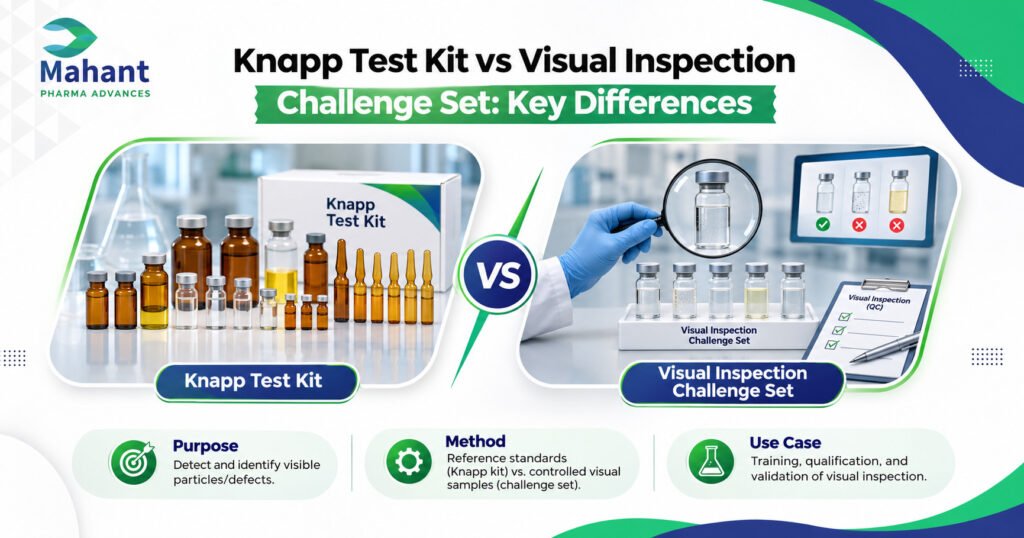
A Knapp test kit is a statistically designed set of containers with characterised defects, used to measure each unit’s probability of detection and prove that inspectors or automated machines perform at least as well as the manual benchmark (the Knapp–Kushner method). A visual inspection challenge set is a broader set of known defects used to train, challenge and routinely check inspectors and inspection systems. Most injectable manufacturers need both: the Knapp kit for formal equivalence and qualification data, and the challenge set for training, ongoing checks and wider defect coverage.
Every injectable product, whether a vial, ampoule, cartridge or prefilled syringe, must be inspected for visible particles, cracks, closure faults and fill errors before release. Because these products go straight into the body, a missed defect can harm patients and trigger recalls. Regulators therefore expect 100 percent inspection, carried out by qualified people or validated machines.
Proving that inspection works is harder than doing it. You need reference units with known defects that you can put in front of inspectors and machines, and records that show what was found and what was missed. Two tools dominate this work: the Knapp test kit and the visual inspection challenge set.
The names are often used interchangeably, and suppliers don’t always define them the same way. That causes confusion at the purchasing stage: teams buy a training set when they need a qualification set, or try to validate an automated machine with a kit that wasn’t built for it.
This guide, written by the team at Mahant Pharma Advances, explains what each kit is, how they differ, where each fits in a visual inspection qualification kit programme, and how to decide which you need.
Understanding the Knapp Test Kit
What it is and why it exists
A Knapp test kit is a collection of containers matched to your production format, in which some units contain characterised defects and the rest are good units. Each unit is blind-coded so inspectors cannot tell which is which.
The kit is built around the Knapp–Kushner method, published by Julius Knapp and Harold Kushner in 1980. The method recognises that visual inspection is probabilistic: a small particle might be seen on one inspection and missed on the next. So instead of asking “was it found?”, it asks “how often is it found?”
- Each unit is inspected many times by experienced inspectors.
- Each unit’s probability of detection (PoD) is calculated.
- Units with high PoD (commonly 0.7 or above) form the reject zone.
- The manual reject zone efficiency (RZE) becomes the benchmark.
- New inspectors or automated systems must match or exceed that benchmark.
Key features and benefits
- Statistical design: produces quantitative PoD and RZE data rather than a simple pass or fail.
- Characterised particles: glass, rubber, metal, fibre and polymer particles of measured size, typically spanning the threshold where detection becomes reliable (USP <1790> notes PoD rising from about 70 percent near 150 µm to above 95 percent at 200 µm and larger).
- Blind coding and documentation: defect records, classification and a certificate of conformance support audit-ready data. Our article on the certified Knapp test kit explains what this documentation should include.
- Manual-to-automated comparability: the same kit runs through people and machines, so results are directly comparable.
The main benefit is defensible evidence. A Knapp study shows, with numbers, that an inspection method is at least as effective as the accepted manual standard.
Applications in the pharmaceutical industry
A Knapp test kit for pharmaceutical industry use is applied to:
- Establishing the manual inspection baseline for a product or container format.
- Qualifying automated (AVI) and semi-automated (SAVI) inspection machines against that baseline.
- Formal qualification and requalification of manual inspectors.
- Assessing the impact of changes to lighting, inspection time, line speed or containers.
- Supporting investigations where particle complaints or deviations occur.
Exploring the Visual Inspection Challenge Set
What it is
A visual inspection challenge set is a set of reference units with known defects used to challenge inspectors and inspection systems. Where a Knapp kit is built for a statistical study, a challenge set is built for coverage and routine use. It typically represents the full range of defects an inspector or machine must recognise, from obvious to subtle.
Industry practice recognises several types of test set, and challenge sets often take one of these forms:
- Training sets with clearly visible, labelled defects for teaching new inspectors.
- Qualification challenge sets with blind-coded particle and non-particle defects for pass-or-fail inspector qualification.
- System suitability or daily check sets, a small set of known defects run through an automated machine at the start and end of a batch or shift.
- Defect libraries that document real production defects by type, size and category to guide training and test set design.
Some suppliers, including Mahant Pharma Advances, also pair challenge sets with inspection reference materials and calibration and documentation guidance for manual and semi-automated inspection. Mahant’s visual inspection challenge sets are designed for manual and semi-automated qualification.
Key features and benefits
- Broad defect coverage: particles plus cracks, chips, closure and crimp faults, under-fill, over-fill, empty units and cosmetic defects.
- Defect classification: units grouped as critical, major or minor, linking results to acceptance criteria. See our guide to critical, major and minor defects in injectables.
- Flexibility: can be configured as a training, qualification or routine-check set.
- Practical use: quick to run, so it suits frequent checks and refresher training.
The main benefit is practical confidence: inspectors learn to recognise every defect type, and machines are shown to still be working before each run.
Applications in the pharmaceutical industry
- Initial training and onboarding of visual inspectors.
- Routine pass-or-fail inspector qualification and annual requalification.
- Start-of-batch and end-of-batch checks on AVI and SAVI machines.
- Refresher training after poor performance, deviations or long absences.
- Demonstrating non-particle defect detection that a particle-focused Knapp kit may not cover.
Key Differences Between a Knapp Test Kit and a Visual Inspection Challenge Set
Side-by-side comparison
The terms overlap in practice, so the table below reflects how they are most commonly used.
| Feature | Knapp test kit | Visual inspection challenge set |
|---|---|---|
| Main purpose | Measure probability of detection and prove equivalence | Train, qualify and routinely check inspectors and systems |
| Core question answered | “How often is each defect found, and is the new method as good?” | “Can this inspector or machine find the defects that matter?” |
| Method | Knapp–Kushner statistical study, repeated inspections | Pass-or-fail or score-based challenge |
| Defect focus | Mainly particles of characterised size, spanning the detection threshold | Full defect range: particles, cracks, closure, fill, cosmetic |
| Typical defect ratio | Commonly 10–20% defective, below 30% | Varies: training sets can be mostly defects; qualification sets usually similar to Knapp kits |
| Output | PoD per unit, RZE, manual vs automated comparison | Detection rate, false rejects, pass or fail |
| Typical frequency | Baseline studies, machine qualification, major changes, requalification | Training, annual requalification, daily or batch checks |
| Data intensity | High: many inspections per unit | Lower: one or a few passes |
| Best for | AVI and SAVI validation; establishing benchmarks | Training, routine qualification, system suitability |
| Blind coding | Essential | Essential for qualification; not needed for training |
Strengths and weaknesses
Knapp test kit
- Strengths: objective, statistical and widely accepted; the standard approach for showing automated inspection is at least as good as manual inspection; makes subtle detection differences visible.
- Weaknesses: time-consuming, since each unit is inspected many times; usually focused on particles, so may not cover every defect type; needs statistical expertise to design and analyse.
Visual inspection challenge set
- Strengths: fast and practical; covers the full range of defect types; suits frequent use for training and system checks; easy for production teams to adopt.
- Weaknesses: a pass-or-fail result gives less insight into borderline detection; on its own it may not satisfy auditors as evidence that automated inspection is equivalent to manual inspection; quality depends heavily on how realistic the defects are.
In short, the Knapp kit tells you how well inspection works; the challenge set tells you whether it works today, across every defect type.
Why Visual Inspection Qualification Kits Matter
Role in ensuring pharmaceutical quality
A visual inspection qualification kit, whether a Knapp kit, a challenge set or both, is the reference standard for your inspection process. Without one, you have no objective way to know whether inspectors are fatigued, lighting has drifted, or a machine recipe has been changed in a way that lets defects through.
A well-designed kit helps you:
- Catch defects before they reach patients.
- Reduce false rejects that waste good product.
- Spot training gaps and inconsistent inspectors.
- Maintain consistent performance across shifts, lines and sites.
Regulatory requirements and compliance
Both kits support the same regulatory framework:
- USP <790> requires injections to be essentially free of visible particulates and sets out inspection conditions.
- USP <1790> explains how to design and qualify inspection processes, including test sets that represent production defects and the comparison of automated and manual inspection.
- Ph. Eur. 2.9.20 describes the test for visible particles, including inspection against black and white backgrounds.
- EU GMP Annex 1 (2022) requires inspector qualification and expects automated inspection to be validated as at least as effective as manual inspection.
- Revised Schedule M in India brings national GMP closer to WHO and PIC/S expectations, raising the bar for documented qualification.
Regulators look for documented qualification, realistic test sets, periodic requalification and evidence that automated systems match manual performance. A Knapp kit supplies the equivalence data; a challenge set supplies the training and routine evidence. Read more in our guide to USP <790> and <1790> visual inspection.
Selecting the Right Kit for Your Needs
Factors to consider
- Inspection method: manual, semi-automated, automated or a mix. Automated or semi-automated lines almost always need a Knapp study.
- Purpose: training, routine qualification, machine validation or system suitability.
- Container format: vials, ampoules, cartridges or prefilled syringes, glass colour and size.
- Product type: clear solution, suspension, emulsion or lyophilised cake.
- Defect history: the defects actually seen in production, complaints and deviations.
- Regulatory markets: US FDA, EU, WHO and Indian expectations for documentation.
- Resources: time and statistical expertise for Knapp studies.
- Supplier support: customisation, characterisation, documentation and requalification.
Recommendations by situation
| Your situation | Recommended kit |
|---|---|
| Installing or upgrading an automated inspection machine | Knapp test kit for qualification, plus a small challenge set for daily checks |
| Manual inspection only, qualifying new inspectors | Visual inspection challenge set (training plus qualification versions) |
| Establishing a manual baseline for a new product | Knapp test kit |
| Frequent particle complaints or deviations | Knapp test kit to measure detection, plus a challenge set to retrain |
| Audit preparation | Both, with full characterisation and documentation |
| Multiple container formats | Separate kits for each container family |
For many sites the answer is both: a Knapp kit pharmaceutical visual inspection kit for formal equivalence studies and a challenge set for daily confidence.
Working with a Knapp test kit manufacturer in India
India is a global hub for injectable manufacturing, and many Indian plants supply regulated export markets. A Knapp test kit manufacturer in India can offer shorter lead times, easier collaboration on custom kits and competitive pricing. Whoever you choose, ask about characterisation records, blind coding, certificates of conformance, customisation to your containers and requalification support. Our guide on how to choose the right Knapp test kit has a full checklist.
Mahant Pharma Advances, with offices in New Jersey, USA, and Pune, India, supplies Knapp test kits, visual inspection challenge sets and CCIT challenge sets, together with inspector training and automated inspection qualification support.
Conclusion
The Knapp test kit vs visual inspection challenge set question isn’t really about choosing one over the other. Each answers a different question. The Knapp kit measures how reliably defects are detected and proves that new inspectors and automated machines meet the manual benchmark. The challenge set trains inspectors, covers every defect type and confirms day to day that your inspection process still works.
Together they form a complete visual inspection qualification programme that satisfies USP <790>, USP <1790>, Ph. Eur. 2.9.20 and EU GMP Annex 1 expectations, and, more importantly, keeps defective units away from patients. Choosing the right combination, built in your own containers and backed by full documentation, is one of the most valuable decisions a quality team can make.
Not sure which kit you need? Contact Mahant Pharma Advances to discuss your products, containers and inspection methods, or read our FAQs.
Frequently Asked Questions
A Knapp test kit is designed for a statistical study that measures each unit’s probability of detection and proves equivalence between manual and automated inspection. A visual inspection challenge set is used to train, qualify and routinely check inspectors and machines across the full range of defect types.
Not for automated inspection qualification. Regulators expect evidence that automated inspection is at least as effective as manual inspection, and the Knapp method is the standard way to show it. A challenge set is better suited to training and routine checks.
Most manufacturers with automated or semi-automated inspection need both. Sites using only manual inspection may rely mainly on challenge sets, though a Knapp study is still valuable for establishing a baseline.
Not exactly. “Visual inspection qualification kit” is a broad term for any kit used to qualify inspectors or machines. A Knapp kit is one specific type, designed for probability-of-detection studies.
Knapp kits are used for baseline studies, machine qualification, major changes and periodic requalification. Challenge sets are used for training, at least annual inspector requalification and, for small system-suitability sets, daily or per-batch checks.
Knapp kits focus on characterised particles of different types and sizes. Challenge sets usually add cracks, closure faults, fill errors and cosmetic defects. Both should reflect the defects actually seen in your production.
Yes, and they should be. Container format, glass colour, fill volume and product type all affect how visible a defect is, so kits are best built in your own containers with your product or a matched fill.
Many companies check kits every 6 to 12 months, record each use in a logbook and replace units whose defects have changed, such as particles stuck to the glass.
One Response