
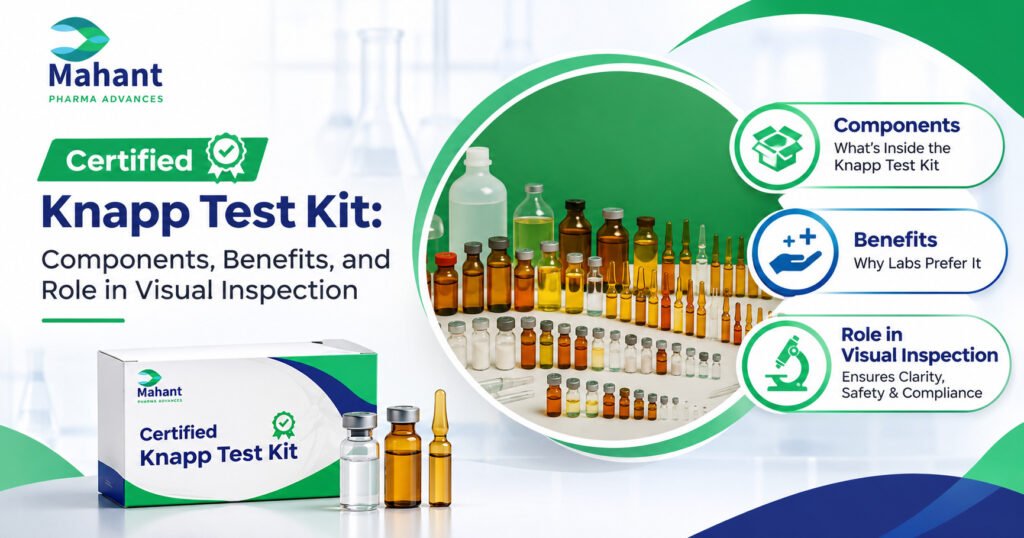
A certified Knapp test kit is a set of pharmaceutical containers with characterised defects and good units, supplied with documentation that proves what each unit contains: a defect list, size and type records, photographs, blind coding and a certificate of conformance. It is used to qualify visual inspectors and inspection machines under USP <790>, USP <1790>, Ph. Eur. 2.9.20 and EU GMP Annex 1, and the certification is what makes those qualification results defensible in an audit.
Every vial, ampoule, cartridge and prefilled syringe of an injectable product must be inspected for visible particles, container damage and fill errors before release. Regulators don’t just expect that inspection to happen; they expect you to prove that your inspectors and machines can reliably find the defects that matter.
The Knapp test kit is the tool that provides that proof. It turns a subjective activity, a person looking at a container under a light, into measurable data. But a kit is only as trustworthy as the evidence behind it. If you can’t show an auditor exactly which defect is in each unit, how big it is and how it was verified, your qualification data is open to question.
That is why QA teams increasingly ask for a certified Knapp test kit. This guide explains what certification actually covers, what a complete kit contains, the benefits for quality and compliance, how the kit supports visual inspection, and what to look for in a Knapp test kit manufacturer in India. It is written by the team at Mahant Pharma Advances, which supplies Knapp test kits and visual inspection challenge sets to injectable manufacturers in India, the USA, Europe, and other markets.
What Is a Certified Knapp Test Kit?
Definition and purpose
A Knapp test kit, often called a Knapp kit, is a collection of containers that match your production format, filled with your product or a similar solution. Some units contain a known defect, such as a glass particle, a rubber fragment, a fibre or a crack; the rest are good units. Each unit carries a unique code that inspectors cannot interpret.
The kit is named after the Knapp–Kushner method, published by Julius Knapp and Harold Kushner in 1980. In this method, each unit is inspected many times, usually by several experienced inspectors, and its probability of detection (PoD) is calculated. Units detected most often (commonly PoD of 0.7 or more) form the reject zone. The manual reject zone efficiency becomes the benchmark that new inspectors, semi-automated systems and fully automated machines must match or exceed.
A Knapp test kit for the pharmaceutical industry is therefore used to:
- Qualify and requalify manual visual inspectors.
- Qualify semi-automated (SAVI) and automated visual inspection (AVI) machines.
- Prove that automated inspection performs at least as well as manual inspection.
- Train inspectors to recognise real defect types.
- Support investigations, deviations and change control.
What “certified” means
There is no single regulatory body that issues a “Knapp kit certificate”. In practice, a certified Knapp test kit means the supplier has characterised every defective unit and provides documented, traceable evidence of it. A credible certification package includes:
- A certificate of conformance confirming the kit was built to the agreed specification.
- A defect characterisation record for every defective unit: defect type, material, size, location and, ideally, a photograph.
- Traceable particle sizing, for example particles measured against calibrated microscopes or reference standards traceable to a national metrology institute such as NIST.
- Blind coding records that link each code to its contents, held by QA rather than inspectors.
- Container and fill details, including container type, volume and lot.
- A quality-managed build process, such as manufacture under an ISO 9001 quality system.
Why certification matters
Without certification, a test kit is just a box of vials. With it, the kit becomes a controlled reference standard. Certification:
- Makes results defensible. Auditors can trace every reject or miss back to a characterised defect.
- Supports data integrity. Documented coding and records align with ALCOA+ expectations for qualification data.
- Enables consistent requalification. You can compare inspector performance year on year against the same known defects.
- Reduces investigation time. When a result looks wrong, you can check the unit’s record instead of re-characterising it.
Essential Components of a Knapp Test Kit
Components of a typical certified kit
| Component | What it is | Why it matters |
| Containers | Vials, ampoules, cartridges or prefilled syringes matching your production format, size and glass colour | Defect visibility depends on container shape, size and clarity |
| Fill | Your product, a placebo or a solution with similar viscosity and colour | Particles move and appear differently in different liquids |
| Particle defect units | Units containing glass, rubber, metal, fibre or polymer particles of measured size | The core of the Knapp study and of USP <790> compliance |
| Non-particle defect units | Cracks, chips, closure faults, under-fill, over-fill and cosmetic defects | Qualification must cover every defect type inspectors must find |
| Good units | Defect-free containers that make up most of the set | Measure false rejects and keep inspectors blind to which units are defective |
| Blind coding | Unique, non-descriptive labels on every unit | Prevents inspectors memorising units and inflating scores |
| Defect classification list | Each defect classified as critical, major or minor | Links kit results to your acceptance criteria |
| Characterisation file and photographs | Size, type and location records for every defect | The evidence auditors ask to see |
| Certificate of conformance | Supplier’s signed confirmation of the kit specification | Formal proof of what you received |
| Storage case and handling guide | Protective packaging plus storage and handling instructions | Protects units and preserves defect integrity |
| Logbook or usage record | A record of each use, check and replacement | Tracks kit condition and supports requalification |
The defect mix matters. Industry guidance commonly describes qualification sets with about 10 to 20 percent defective units, and always under 30 percent. USP <1790> notes that a single particle’s probability of detection typically rises from about 70 percent at around 150 µm to over 95 percent at 200 µm and above, so a meaningful kit includes particles both below and above that threshold. For classification guidance, read our article on critical, major and minor defects in injectables.
Variations for specific uses
Not every kit does the same job. The main variations are:
- Particle (Knapp) set: focused on particles of known size and type; used to compare manual and automated inspection.
- Visual inspection qualification kit: a broader set including particle and non-particle defects, used for formal inspector and machine qualification.
- Training set: clearly visible, labelled defects for teaching; not blind-coded, and not used for qualification.
- Functional or system-suitability set: a small set of obvious defects used to check an automated machine at the start and end of a batch.
- Product-specific or custom kit: built in your own containers and product, often needed for suspensions, lyophilised cakes, amber glass or prefilled syringes.
A visual inspection test kit for an amber-glass vial line will look very different from one for clear ampoules, so most manufacturers hold several kits, one for each container family.
Benefits of Using a Certified Knapp Test Kit
A certified pharmaceutical visual inspection kit improves both quality assurance and regulatory compliance.
- Objective measurement of inspection performance. Knapp data replaces “the inspector seems good” with a measured detection rate for each defect type and size.
- Regulatory alignment. It provides the evidence expected under USP <790> and <1790>, Ph. Eur. 2.9.20 and EU GMP Annex 1 (2022), which requires inspector qualification and expects automated inspection to be validated against manual performance. In India, the revised Schedule M has moved national GMP requirements closer to WHO and PIC/S expectations, which raises the bar for documented inspection qualification.
- Audit readiness. Characterisation files, coding records and certificates give auditors a complete, traceable trail.
- Confident automation. Knapp comparison shows that an automated machine is at least as effective as manual inspection before it replaces or supplements people.
- Fewer escapes and false rejects. A realistic kit finds weak points in training, lighting, inspection timing or machine recipes, which reduces both defects reaching patients and good product being rejected.
- Consistent requalification. The same characterised units can be used over time, so performance trends are meaningful.
- Faster investigations. When complaints or deviations involve particles, the kit helps confirm whether the inspection process could have detected that defect.
The Role of the Knapp Test Kit in Visual Inspection
Why visual inspection matters
Injectable products enter the body directly, bypassing many natural defences. Visible particles, cracked containers or failed closures can harm patients and compromise sterility. Visible particulates are among the most common reasons for injectable product recalls.
Pharmacopoeias therefore require 100 percent inspection of injectable units. Typical manual inspection conditions follow Ph. Eur. 2.9.20 and USP <790>: inspection against black and white backgrounds, light intensity of roughly 2,000 to 3,750 lux, and about 5 seconds of viewing against each background. Manufacturers may use manual inspection, semi-automated inspection or fully automated camera-based machines, and often a combination. Our guide to USP <790> and <1790> visual inspection explains these requirements in detail.
How the Knapp test kit supports visual inspection
The Knapp kit is the measuring stick for the whole inspection process:
- Establishing the baseline. Experienced inspectors inspect the kit repeatedly to determine each unit’s PoD and the manual reject zone efficiency.
- Qualifying inspectors. New and existing inspectors inspect the blind-coded kit and must meet defined acceptance criteria, typically at initial qualification and at least once a year after that.
- Validating automated machines. The same kit runs through the AVI or SAVI system; the machine must match or beat the manual baseline.
- Testing inspection conditions. Changes to lighting, booth design, inspection time or machine settings are checked against the kit before release.
- Supporting change control. New containers, products or line speeds are assessed against a kit built for that format.
- Monitoring over time. Regular use reveals declining inspector performance, fatigue issues or drifting machine settings.
Because inspectors cannot tell which units are defective, the kit reflects real inspection conditions, which is exactly what regulators want to see.
Choosing a Reliable Knapp Test Kit Manufacturer in India
India is one of the world’s largest producers of injectables, and many Indian plants supply the USA and Europe. Working with a Knapp test kit manufacturer in India can mean shorter lead times, easier collaboration on custom kits, competitive pricing and support from people who understand the expectations of both domestic and export regulators.
When evaluating any supplier, look for:
- Characterisation and certification: a full documentation pack with a certificate of conformance and photographs for every defect.
- Traceable sizing: clear information on how particle sizes are measured and verified.
- Customisation: kits built in your containers, with your product or a matched fill.
- Defect range: particle and non-particle defects across the detection range, not just obvious ones.
- Quality system: a documented build process under a recognised quality management system.
- Technical support: help with Knapp study design, PoD calculations and acceptance criteria.
- Requalification service: periodic checks, replacement of degraded defects and kit maintenance.
- References: experience with regulated injectable manufacturers.
For a step-by-step buying checklist, see our guide on how to choose the right Knapp test kit for pharmaceutical inspection.
Mahant Pharma Advances has offices in New Jersey, USA, and Pune, India. Alongside Knapp kits, it supplies visual inspection challenge sets and CCIT challenge sets for container closure integrity testing, together with inspector training and automated inspection qualification support. Its Knapp kits are supplied with a defect classification list, a storage and handling guide and a certificate of conformance.
Conclusion
A certified Knapp test kit is more than a set of defective vials. It is a controlled reference standard that lets you measure, prove and maintain the performance of your visual inspection process. Its value lies in the combination of realistic defects, matched containers, blind coding and complete, traceable documentation.
Used well, it qualifies your inspectors, validates your automated machines, supports audits and helps keep defective units away from patients. Choosing a supplier that can certify every defect, customise kits for your containers and support requalification is one of the most effective investments a quality team can make.
Need a certified Knapp kit or visual inspection qualification kit for your products? Contact Mahant Pharma Advances to discuss your containers, defects and qualification requirements, or explore our Knapp test kit range.
Frequently Asked Questions
It is a Knapp test kit supplied with documented proof of its contents: a certificate of conformance, characterisation records for each defect, photographs, traceable particle sizing and blind coding records. This makes it suitable for formal qualification studies.
No regulator certifies Knapp kits directly. The kit manufacturer characterises and certifies the contents, ideally using calibrated, traceable measurement under a recognised quality system. Your QA team then approves the kit for use under your SOPs.
It varies with the study design and number of container formats. Many kits contain from a few dozen to a few hundred units, with typically 10 to 20 percent defective units and always under 30 percent.
Many companies check kits every 6 to 12 months, record each use in a logbook and replace units whose defects have changed, for example particles that have stuck to the glass. Inspectors are typically requalified at least annually.
Yes. It is the standard way to show that an automated or semi-automated system performs at least as well as manual inspection, as USP <1790> and EU GMP Annex 1 expect.
Usually not. Container format, glass colour, fill volume and product type all change how defects look, so kits are normally needed for each container family or product type.
Store it in its protective case at the temperature stated by the supplier, away from direct light, and handle units gently to avoid creating new defects. Keep the coding key under QA control, separate from the kit.
2 Responses