
What Is USP <1207> and How Does It Impact CCIT Testing?
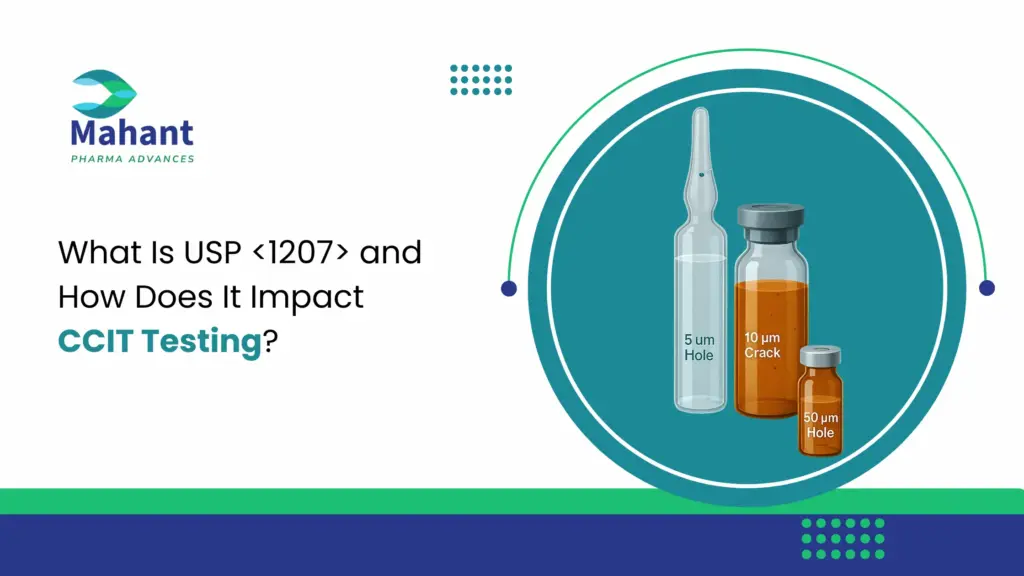
USP (the United States Pharmacopeia) sets public quality standards for medicines. Its general chapter USP <1207>, Package Integrity Evaluation – Sterile Products, guides how pharmaceutical companies perform container closure integrity testing (CCIT). It recommends a risk-based, lifecycle approach, setting a maximum allowable leakage limit (MALL) for each product, and prefers deterministic, quantitative methods such as vacuum decay, high voltage leak detection and laser headspace analysis over probabilistic methods such as dye ingress.
A sterile injectable is only as safe as the container that holds it. A microscopic gap between a vial and its stopper, a hairline crack in an ampoule or a poorly sealed syringe can let in microorganisms, oxygen or moisture. The result can be a contaminated or degraded product reaching a patient.
That’s why container closure integrity testing is a critical quality control in sterile manufacturing. And when it comes to how CCIT should be done, one reference shapes practice more than any other: USP 1207.
This guide explains what USP is, what CCIT testing involves, what the USP 1207 guidelines require, the main CCIT testing methods with their strengths and limits, and why container closure integrity testing in pharma matters for patient safety and regulatory compliance.
It’s written by the team at Mahant Pharma Advances, which supplies CCIT challenge sets, Knapp test kits and visual inspection challenge sets to injectable manufacturers in the USA, Europe, India and other markets. Our CCIT kits provide the positive and negative control samples that laboratories use to qualify and validate leak test methods.
Understanding USP
What Is USP (U.S. Pharmacopeia)?
The United States Pharmacopeia (USP) is an independent, non-profit scientific organisation that sets public standards for the identity, strength, quality and purity of medicines, dietary supplements and food ingredients. Its standards are published in the United States Pharmacopeia–National Formulary (USP–NF).
USP standards are recognised in US law, and the US Food and Drug Administration (FDA) can enforce USP monographs and mandatory general chapters for drugs marketed in the United States.
How USP Chapters Work
USP general chapters fall into two broad groups:
| Chapter numbers | Type | What it means |
| Below <1000> | Mandatory requirements | Tests and procedures that are enforceable when referenced in a monograph |
| <1000> and above | Informational guidance | Best-practice recommendations that explain how to meet requirements |
USP <1207> is an informational chapter. It doesn’t mandate a specific test, but regulators and auditors widely treat it as the benchmark for scientifically sound container closure integrity programmes.
USP’s Role in Pharmaceutical Standards and Practices
USP standards help manufacturers and regulators speak the same language. For sterile products, relevant USP chapters include:
- <71> Sterility Tests
- <790> Visible Particulates in Injections and <1790> Visual Inspection of Injections
- <1207> Package Integrity Evaluation – Sterile Products
Visual inspection and CCIT work together: one finds visible particles and defects, the other finds leaks too small to see. Read more in our guide to USP <790> and <1790> visual inspection.
What Is CCIT Testing?
Definition and Purpose
A container closure integrity test checks whether a sealed pharmaceutical package, such as a vial, ampoule, prefilled syringe, cartridge or bag, prevents product loss and keeps out contaminants.
Container closure integrity (CCI) is the ability of the container closure system to:
- Keep microorganisms out, maintaining sterility
- Keep the product in, preventing leakage
- Protect against oxygen, moisture and other gases, where they affect product quality
- Maintain any special headspace conditions, such as vacuum or inert gas
CCIT testing verifies this ability throughout the product lifecycle, from development to commercial manufacturing and stability studies.
Why CCIT Matters for Product Safety
A leak doesn’t have to be visible to be dangerous. Defects of only a few micrometres can allow microbial ingress or gas exchange. Risks include:
- Microbial contamination, which can cause serious infections in patients receiving injections
- Loss of potency, when oxygen or moisture degrades sensitive drugs and biologics
- Product loss or concentration changes, from evaporation or leakage
- Recalls and regulatory action, with major costs and damage to reputation
Sterility testing alone can’t guarantee sterility over a product’s shelf life. FDA’s 2008 guidance, Container and Closure System Integrity Testing in Lieu of Sterility Testing as a Component of the Stability Protocol for Sterile Products, recognises that validated CCI tests can replace sterility tests in stability programmes. That makes CCIT central to demonstrating ongoing sterility.
USP 1207 Guidelines
Overview of USP 1207
USP <1207>, Package Integrity Evaluation – Sterile Products, was rewritten and became official on 1 August 2016, as part of the first supplement to USP 39–NF 34. It replaced an older, much shorter chapter and introduced a modern, science-based approach to CCIT.
The chapter is organised into four parts:
| Chapter | Focus |
| <1207> | Overview, key principles and glossary |
| <1207.1> | Package integrity testing in the product lifecycle: test method selection and validation |
| <1207.2> | Package integrity leak test technologies |
| <1207.3> | Package seal quality test technologies |
Key Principles of the USP 1207 Guidelines
- Lifecycle approach: Package integrity should be evaluated during development, validation, commercial manufacturing and stability, not just once.
- Maximum allowable leakage limit (MALL): Each product should have a defined MALL, meaning the largest leak rate (or leak size) that poses no risk to product safety and quality. The test method must be able to detect leaks at or below this limit.
- Deterministic methods are preferred: USP <1207> favours deterministic methods, which produce quantitative, objective and reproducible results, over probabilistic methods, which depend on chance events and operator judgement.
- Method validation: Every method must be validated for the specific product and package, using positive controls (containers with known, created defects) and negative controls (known good containers).
- Seal quality matters too: Tests such as residual seal force help confirm that the closure is applied consistently, complementing leak tests.
- Science and risk-based selection: No single method suits every product. The choice depends on package type, contents, headspace, MALL and production stage.
Deterministic vs Probabilistic Methods
| Feature | Deterministic methods | Probabilistic methods |
| Basis | Physical measurement with predictable outcome | Chance events, such as dye or microbes passing through a leak |
| Results | Quantitative and objective | Often qualitative and operator-dependent |
| Sensitivity | Generally higher and more consistent | Generally lower and more variable |
| Destructive? | Many are non-destructive | Usually destructive |
| 100% inspection | Often possible | Not practical |
| USP <1207> view | Preferred wherever a MALL can be established | Still allowed, but less favoured |
Why Compliance With USP 1207 Matters
- Regulatory expectations: FDA and other agencies expect CCI programmes to reflect current science, and auditors frequently reference USP <1207>.
- Global alignment: The revised EU GMP Annex 1 (effective 25 August 2023) requires 100% integrity testing of containers closed by fusion, such as ampoules and blow-fill-seal units, and no longer accepts visual inspection as an integrity test.
- Patient safety: Sensitive, validated methods catch leaks that older tests miss.
- Fewer investigations and rejections: Objective data reduces disputes over borderline results.
CCIT Testing Methods
USP <1207.2> describes a range of CCIT testing methods. The detection limits below are typical values reported in published literature and by equipment suppliers; actual performance depends on the product, package and validation.
Deterministic Methods
- Vacuum Decay
The container is placed in a sealed test chamber and a vacuum is applied. A leak causes a measurable pressure rise.
- Advantages: Non-destructive, quantitative, widely used, standardised under ASTM F2338; detects defects down to about 5 µm in suitable rigid packages
- Limitations: Less suitable for very flexible packages; performance depends on product and headspace
- High Voltage Leak Detection (HVLD)
A high-voltage, low-current signal is passed across the container. A leak path filled with conductive liquid changes the current flow.
- Advantages: Non-destructive, fast, suitable for 100% inline inspection of liquid-filled vials, ampoules and syringes; sensitive to defects of a few micrometres
- Limitations: Requires conductive liquid at the leak site; product compatibility with electrical exposure must be assessed for sensitive biologics
- Laser-Based Headspace Gas Analysis
A laser measures gases such as oxygen, carbon dioxide or water vapour, or pressure, in the container’s headspace. Changes indicate a leak.
- Advantages: Non-destructive, rapid and suitable for 100% inspection; ideal for lyophilised products and those with a vacuum or inert headspace
- Limitations: Needs a measurable headspace and a transparent container; leak detection may take time as gases equilibrate
- Helium Leak Detection (Tracer Gas, Mass Spectrometry)
Containers are filled with helium, and a mass spectrometer measures helium escaping through any leak.
- Advantages: The most sensitive CCIT method, able to detect very small leaks; ideal for development studies and determining MALL
- Limitations: Usually destructive, needs helium filling and is not suited to routine 100% inspection
- Pressure Decay and Mass Extraction
Pressure decay measures pressure change in a pressurised container or chamber. Mass extraction measures gas flow out of the package under vacuum.
- Advantages: Quantitative and non-destructive for suitable packages
- Limitations: Sensitivity depends on package design and test conditions
Probabilistic Methods
- Dye Ingress
Containers are immersed in a dye solution under pressure or vacuum, then inspected for dye that has entered.
- Advantages: Simple and inexpensive; long history of use
- Limitations: Destructive, operator-dependent and less sensitive; typically reliable only for larger defects, around 20 µm and above
- Microbial Ingress (Immersion)
Filled containers are immersed in a high concentration of bacteria and incubated to see whether microbes enter.
- Advantages: Directly demonstrates a microbial barrier
- Limitations: Destructive, slow, variable and labour-intensive
- Bubble Emission
The package is immersed in liquid and pressurised; bubbles show the location of a leak.
- Advantages: Simple; helps locate gross leaks
- Limitations: Qualitative and suitable only for larger defects
CCIT Methods at a Glance
| Method | Type | Destructive? | Typical use |
| Vacuum decay | Deterministic | No | Vials, syringes, ampoules, rigid packages |
| HVLD | Deterministic | No | Liquid-filled containers, 100% inline testing |
| Laser headspace analysis | Deterministic | No | Lyophilised and headspace-controlled products |
| Helium leak detection | Deterministic | Usually | Development, MALL studies, high sensitivity |
| Pressure decay / mass extraction | Deterministic | No | Suitable rigid and semi-rigid packages |
| Dye ingress | Probabilistic | Yes | Legacy and supplementary testing |
| Microbial ingress | Probabilistic | Yes | Supplementary microbial barrier studies |
| Bubble emission | Probabilistic | Varies | Gross leak location |
The Role of Positive and Negative Controls
Every CCIT method must prove it can detect the leaks that matter. Validation uses:
- Positive controls: Containers with known, artificially created defects, such as laser-drilled micro-holes or micro-tubes of defined size
- Negative controls: Known intact containers from the same package system
These controls show the method’s detection limit, false-reject and false-accept rates, and day-to-day reliability. Mahant Pharma Advances’ CCIT challenge sets provide documented positive and negative control samples for vials, ampoules and syringes, compatible with methods such as vacuum decay, HVLD and pressure decay.
Container Closure Integrity Testing in Pharma
Why CCIT Matters Across the Product Lifecycle
Container closure integrity testing in pharma isn’t a single test. It’s a programme that supports decisions at every stage:
| Lifecycle stage | Role of CCIT |
| Development | Select packaging components, set the MALL and choose methods |
| Validation | Qualify the packaging and validate the CCIT method |
| Commercial production | Routine testing, or 100% testing where required |
| Stability studies | Confirm integrity over shelf life, in place of sterility testing where justified |
| Changes | Re-evaluate after changes to components, suppliers or processes |
| Transport | Confirm integrity after shipping and handling stresses |
Practical Examples of CCIT Implementation
The following examples show how manufacturers typically apply USP <1207> principles. They’re illustrative scenarios, not specific company case studies.
Example 1: Moving from dye ingress to vacuum decay for vials
A manufacturer of liquid vials relies on dye ingress for stability testing. To align with USP <1207>, it validates vacuum decay using positive controls with defined micro-holes. The result is objective, non-destructive data, fewer operator-dependent results and the ability to test more units.
Example 2: 100% integrity testing for ampoules under Annex 1
A company supplying ampoules to Europe must test 100% of fusion-sealed units under EU GMP Annex 1. It installs inline HVLD, validated with certified defect samples, and documents the detection limit against its MALL.
Example 3: Laser headspace analysis for a lyophilised biologic
A biologic is stored under vacuum in vials. The manufacturer uses laser headspace analysis to confirm that vacuum is maintained across shelf life, detecting leaks without opening or destroying the vials.
Building a Robust CCIT Programme
- Understand your package: Materials, closure design, headspace and contents.
- Define the MALL: Based on product sensitivity and risk.
- Select fit-for-purpose methods: Prefer deterministic methods where possible.
- Validate with proper controls: Use documented positive and negative controls that represent real defects.
- Combine with seal quality and visual inspection: Each catches different defect types. See our guide to critical, major and minor defects in injectables.
- Review over the lifecycle: Re-evaluate after changes and trend the results.
Conclusion
USP sets the standards that help keep medicines safe, and USP 1207 is the key reference for container closure integrity testing. It shifted the industry towards a lifecycle, risk-based approach, built around a product-specific maximum allowable leakage limit and a preference for deterministic, quantitative methods.
For pharmaceutical manufacturers, a strong CCIT programme protects patients from contamination, preserves product quality, satisfies FDA and EU expectations, and reduces costly investigations and recalls. The right combination of validated methods, reliable positive and negative controls, seal quality testing and visual inspection gives the most complete assurance of package integrity.
Following USP <1207> isn’t just about compliance. It’s about making sure every sterile product reaches the patient exactly as it left the production line.
Need reliable controls for your CCIT validation? Explore Mahant Pharma Advances’ CCIT challenge sets, Knapp test kits and visual inspection challenge sets, or contact our team for expert guidance.
Frequently Asked Questions
USP <1207>, Package Integrity Evaluation – Sterile Products, is a USP general chapter that guides how to evaluate the integrity of sterile product packages. It covers method selection, validation, leak test technologies and seal quality tests.
USP <1207> is an informational chapter (numbered above <1000>), so it isn’t a mandatory test in itself. However, regulators and auditors widely expect CCI programmes to follow its principles.
Deterministic methods measure a physical property and give quantitative, reproducible results. Probabilistic methods rely on chance events, such as dye or microbes passing through a leak, and are more variable. USP <1207> prefers deterministic methods.
MALL stands for maximum allowable leakage limit: the largest leak that poses no risk to a product’s sterility or quality. It’s product-specific and determines how sensitive the CCIT method must be.
Dye ingress isn’t banned, but USP <1207> considers it less reliable than deterministic methods because it’s probabilistic, destructive and operator-dependent. Many manufacturers are replacing it or using it only as a supplementary test.
In stability programmes, FDA’s 2008 guidance allows validated CCI tests to replace sterility testing. It doesn’t replace sterility testing required for batch release.
Positive controls are containers with known, deliberately created defects of defined size. They prove the test method can detect leaks at the required sensitivity during validation and routine use.