
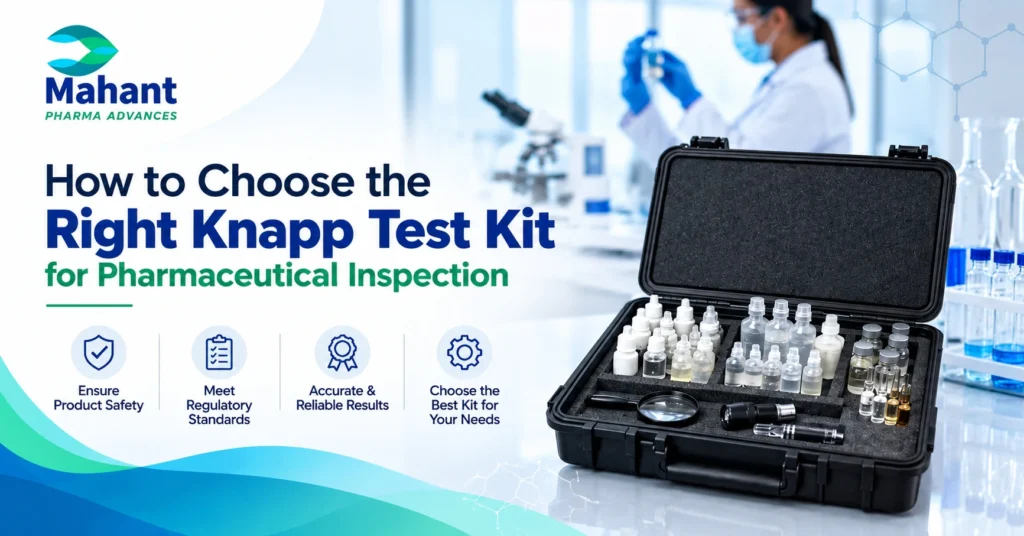
A Knapp test kit is a set of filled containers, such as vials, ampoules or syringes, that hold known, documented defects mixed with defect-free units. Pharmaceutical manufacturers use it to measure how reliably their inspectors and inspection machines find visible particles and other defects in injectable products.
Every unit of a parenteral product must be inspected before release. EU GMP Annex 1 states that “all filled containers of parenteral products should be inspected individually for extraneous contamination or other defects” (EU GMP Annex 1, 8.30). Inspection only protects patients if it works, though, and proving that it works is the job of a Knapp test kit.
Choosing the kit matters because the kit sets the benchmark. If the kit’s particles are too large, too few or poorly documented, inspectors will pass qualification easily and the inspection process will look stronger than it is. If the kit doesn’t match your containers or product, the results won’t tell you much about real production. A well-chosen Knapp test kit for the pharmaceutical industry gives you a fair, repeatable and defensible measure of inspection performance.
This guide explains what Knapp test kits are, which types exist, what to check in specifications and standards, how to judge a Knapp test kit manufacturer, and how to match a kit to your inspection program.
Understanding Knapp Test Kits
Definition and purpose
The Knapp method is a statistical way of measuring inspection performance. It starts from a simple fact: visual inspection is probabilistic. A person or machine will not catch every defect every time, and the chance of detection depends on the size of the particle, the container, the product and the inspection conditions. USP <1790> notes that particles are reliably detected (with at least 70% probability) when they are generally 150 µm or larger, and that detection typically exceeds 95% for particles of 200 µm and above (USP <1790> briefing text).
Rather than labelling each container simply “good” or “bad”, the Knapp test for visual inspection measures each container’s probability of detection (PoD). Qualified inspectors inspect every unit in the set many times, and the PoD is the fraction of inspections in which the unit was rejected. The units are then sorted into three zones (A3P case study):
| Zone | Probability of detection | Meaning |
| Reject zone | 70% or higher | Defects that should be reliably rejected |
| Grey zone | 30% to under 70% | Borderline defects that are sometimes caught |
| Accept zone | Under 30% | Units that should be accepted |
From the reject zone you calculate the reject zone efficiency (RZE): the average detection rate for the reject-zone units. Manual RZE becomes the benchmark. When an automated inspection machine is run against the same kit, its RZE must be equal to or higher than the manual RZE. This mirrors Annex 1, which requires automated inspection to be “equal to, or better than, manual inspection methods” (EU GMP Annex 1, 8.32).
In practice, a Knapp test kit serves four purposes:
- Qualifying and requalifying manual inspectors against a known standard
- Validating automated and semi-automated inspection machines by comparison with manual performance
- Training inspectors to recognize real defect types
- Providing documented evidence of inspection performance for audits
Types of Knapp test kits available
Knapp test kits are usually built to order, so “types” really describe what the kit is designed to do:
- Manual inspector qualification sets: containers with characterized particles and container defects, used to qualify inspectors at an inspection booth. USP <1790> recommends limiting defective units to about 10% of the set to prevent rejection bias.
- Automated visual inspection (AVI) challenge sets: larger or more robust sets that can run repeatedly through an inspection machine, used for validation and for routine challenges before start-up and during the batch.
- Container-specific sets: made in your own vials, ampoules, prefilled syringes or cartridges, because glass thickness, curvature and size all change how visible a particle is.
- Product-specific sets: filled with a solution that matches your product’s colour, viscosity or appearance. Suspensions, coloured solutions and lyophilized cakes need sets that reflect how hard they are to inspect (see our guide to inspecting lyophilized vials).
- Defect-library reference sets: a broader collection of particle, container and closure defects used for training and for building the defect library that Annex 1 expects.
A Knapp test kit is different from a container closure integrity (CCI) kit. Knapp kits challenge visual inspection; leak testing uses separate positive and negative controls, such as CCIT challenge sets.
Key Considerations When Choosing a Knapp Test Kit
The right Knapp test kit matches your containers and product, covers your real defect risks with documented characterization, supports the standards you are inspected against, and comes from a manufacturer that can prove how each unit was made and measured.
Product specifications
Start with what the kit contains and how closely it resembles your production units:
- Container format and size: the same vial, ampoule, syringe or cartridge type (and ideally the same glass and closure) that you fill. A particle that is easy to see in a 2 mL ampoule can be much harder to see in a 50 mL vial.
- Fill and product appearance: a fill volume and solution matching your product, including colour, viscosity or opacity where relevant.
- Defect types: particles that reflect your process risks, such as glass, fibres, rubber and metal, plus container and closure defects (cracks, scratches, missing or misaligned stoppers) and fill-level problems. Classifying defects as critical, major or minor helps you weight them by risk (see critical, major and minor defects in injectables).
- Particle size range: a spread around the detection threshold, not only large, obvious particles. Units in the grey zone are what reveal real differences between inspectors and machines.
- Defect ratio: around 10% defective units, as USP <1790> recommends, so inspectors don’t simply expect to find defects.
- Unit identification: each container numbered or coded discreetly, so results can be traced without giving inspectors a hint.
- Characterization data: documented defect type, size and, ideally, manual PoD for each unit.
Compliance with industry standards
A Knapp test kit doesn’t carry a regulatory approval of its own. What matters is whether it lets you meet the requirements you are inspected against. The main ones are:
- USP <790> Visible Particulates in Injections: requires 100% inspection under controlled conditions. The light level at the inspection point is 2,000 to 3,750 lux, and each container is viewed for 5 seconds against a black background and 5 seconds against a white one (CAI summary of USP <790>). Ph. Eur. 2.9.20 describes comparable conditions.
- USP <1790> Visual Inspection of Injections: the guidance chapter on inspection lifecycle, test set preparation and inspector qualification. It recommends that inspectors pass three successful inspections of the test set for initial qualification, with a target of under 5% of good units falsely rejected, and requalification at least annually.
- EU GMP Annex 1 (2022), paragraphs 8.30 to 8.33: requires a maintained defect library, annual inspector qualification using samples from that library under worst-case conditions, eyesight checks, and automated inspection that is equal to or better than manual inspection.
- FDA draft guidance (December 2021), Inspection of Injectable Products for Visible Particulates: recommends a holistic, risk-based approach and notes that meeting a compendial standard alone is generally not enough to satisfy CGMP (FDA).
For a deeper look at the USP chapters, see our guide to USP <790> and <1790>.
Manufacturer reputation and expertise
A Knapp test kit is only as reliable as the way it was made. When you compare suppliers, ask each one:
- How are particles made, measured and fixed? You want the particle type and size recorded for each unit, and particles that don’t break up, dissolve or stick to the glass over time.
- What documentation comes with the kit? Look for a defect classification list, a certificate of conformance, characterization data, and handling and storage instructions.
- Can the kit be built in our containers and product-like fill? Customization is often what separates a useful kit from a generic one.
- What quality system do you work under? Ask for certificates rather than accepting general claims.
- Who can we talk to? References from companies with similar products are more useful than general testimonials.
As a Knapp test kit manufacturer, Mahant Pharma Advances states that its Knapp Test Kitincludes pre-characterized ampoules or vials with particulates (glass, fibre, rubber), cosmetic defects and fill-volume anomalies, together with a defect classification list, a storage and handling guide and a certificate of conformance. The company also offers kits customized to container type and defect challenge. Ask for sample documentation before you order, from Mahant or any other supplier.
Application of Knapp Test Kits in the Pharmaceutical Industry
Visual inspection procedures
In a typical pharmaceutical visual inspection program, the Knapp test kit is used at four points:
- Building the baseline: a group of qualified inspectors inspects the kit repeatedly (for example, 5 inspectors × 10 rounds = 50 results per unit, as in the A3P case study) to set each unit’s PoD and the manual RZE.
- Qualifying inspectors: each new inspector inspects the kit under standard conditions, and results are compared with the acceptance criteria in your SOP. Our step-by-step guide to qualifying inspectors with the Knapp test covers this in detail.
- Validating machines: the kit runs repeatedly through the automated or semi-automated inspection system, and the machine’s RZE is compared with the manual RZE.
- Ongoing checks: periodic requalification, and challenges to automated equipment “prior to start up and at regular intervals throughout the batch”, as Annex 1 (8.32) requires.
Importance in injectable product inspection
Injectable product inspection carries high stakes because the product goes directly into the bloodstream, tissue or eye. Visible particles can cause harm to patients and lead to recalls. Without an objective standard, an inspector’s performance is a matter of opinion. With a Knapp test kit, you have numbers: how often each defect is caught, how often good units are wrongly rejected, and whether a machine performs at least as well as people. That evidence is what auditors look for when they review a visual inspection program.
Role in pharmaceutical particle inspection
Pharmaceutical particle inspection depends on detecting particles near the limit of human vision. Because detection is probabilistic, a kit with only large particles tells you little. A kit with a range of characterized sizes and materials shows where your detection threshold lies, which particle types are hardest to see in your product, and whether lighting, inspection time or training needs to change. Trending these results over time also supports the defect trending that Annex 1 (8.33) requires.
Selecting the Right Knapp Test Kit for Your Needs
Matching the kit with specific inspection requirements
| If you need to… | Look for a kit that… |
| Qualify manual inspectors | Uses your container, has ~10% defects with a spread of sizes, and includes PoD data |
| Validate an automated machine | Withstands repeated machine runs and covers the defects the machine is set to detect |
| Inspect difficult products (suspensions, coloured, lyophilized) | Uses a product-like fill or cake, not clear water |
| Build a defect library | Covers particle, container, closure and fill defects, classified by criticality |
| Handle several container formats | Comes as separate sets per format, not one mixed set |
For broader training, lighting and reference needs, a Visual Inspection Challenge Set can complement the Knapp kit.
Cost vs. quality considerations
The cheapest kit can be the most expensive choice. A kit with poorly characterized or unstable particles can lead to failed audits, repeated qualification work or an inspection process that misses real defects. Compare suppliers on the cost of ownership, not only the purchase price: documentation, customization, how long the kit stays usable, and whether recertification is offered. Spend most on the sets that carry the highest risk, usually those for critical products and automated machine validation.
Maintenance and support services
Particles can settle, stick or degrade, and containers can be scratched with handling. Ask the supplier about storage conditions, recommended inspection of the kit itself, shelf life and recertification (see Knapp test kit storage, shelf life and recertification). Also check whether the supplier helps with inspector training, AVI qualification and replacement units. Mahant Pharma Advances states that it supports customers with inspector training and AVI qualification.
Conclusion
The right Knapp Test Kit gives you measured proof that inspectors and machines find the defects that matter. Match the kit to your container, fill and inspection method. Include defects near your lower particle limit, insist on traceable units and certificates, and plan recertification before the shelf life ends. Treat every supplier claim, including ours, as something to verify.
To discuss a kit for your injectable product inspection programme, contact Mahant Pharma Advances through its contact page, email info@mahantpharmaadvances.com, or call +1 (732) 519-2503 in the USA or +91 83207 01646 in India. You can also browse the Mahant Pharma Advances blog for more on visual inspection.
Frequently Asked Questions
A Knapp test kit is a set of filled containers with known, characterized defects and defect-free units. It is used to qualify visual inspectors and to validate automated inspection machines for injectable products, using the Knapp probabilistic method.
Qualified inspectors inspect every unit many times to establish each unit’s probability of detection. Units detected 70% of the time or more form the reject zone, and their average detection rate is the reject zone efficiency. Inspectors and machines are then measured against that benchmark; machines must perform equal to or better than manual inspection.
Knapp test kits challenge inspection for visible particles (glass, fibres, rubber, metal), container defects (cracks, scratches), closure defects and fill-level problems. The results show which defects inspectors or machines miss, so you can improve training, lighting or machine settings.
Injectable products bypass the body’s natural defences, so particles or container defects can harm patients. USP <790> and EU GMP Annex 1 require 100% inspection of parenteral products, and regulators expect manufacturers to show that their inspection process reliably detects defects.
Store the kit as the manufacturer instructs, handle containers carefully, inspect the kit regularly for damage or changes in particles, and recertify or replace units when required. Keep usage records so you can show auditors the kit is still fit for purpose. Inspectors themselves should be requalified at least annually (how often to requalify inspectors).